Director Sam Blair explores how sport fueled political power in ‘Berlusconi: Condemned to Win’

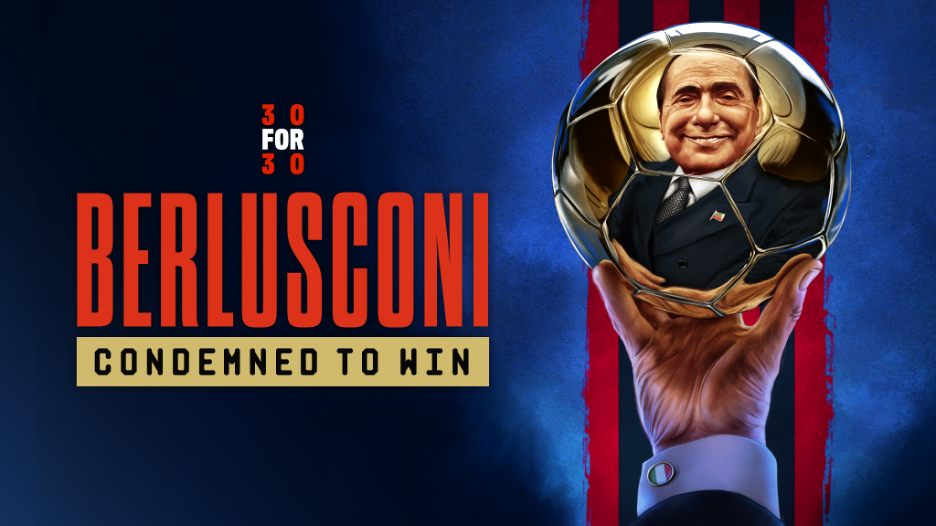
ESPN’s acclaimed 30 for 30 documentary series returns tonight with the premiere of “Berlusconi: Condemned to Win,” examining the life and legacy of Silvio Berlusconi, one of the most influential — and controversial — figures in modern Italian history. Berlusconi made his mark as a business and media tycoon before purchasing A.C. Milan, one of the country’s most storied football clubs. Under his ownership, the team delivered unprecedented victories on the pitch — and Berlusconi leveraged this to fuel his own popularity, ascending Italy’s political ladder with three separate stints as prime minister. The film interrogates how the spectacle of winning can obscure corruption, reshape national identity and even open a pathway to power with lasting consequences.
Front Row spoke with the film’s director Sam Blair about what drew him to Berlusconi’s story, the challenges of telling it and what audiences can expect from this new 30 for 30.
The documentary spans decades of Italian history. What were the biggest challenges in weaving sport, politics and culture into one cohesive narrative?
Through the sweep of the series, from the early 80s to the late 00s, we see not only the evolution of Berlusconi and his empire, but also his transformation of Italy, which is a remarkable thing to see play out. There is real scale to the story, and Italy is such a richly characterful place that it was really a gift to us to be able to weave those elements together. Ultimately, their interplay is the story. As the series develops, Berlusconi’s power, AC Milan’s success and Italian culture seem increasingly locked in a mortal embrace, and it presented us with extraordinary, dramatic moments to evoke. The biggest challenge was probably navigating the hold that Berlusconi had, and his companies still have, over the media in Italy. There’s a Wizard of Oz quality to the way he shaped reality, and it’s difficult to get past that, even now.
Berlusconi is both celebrated and vilified. As a storyteller, how did you navigate the tension between those extremes to create a balanced portrait?
That repulsion and attraction fascinated me, and many of the interviewees in the series struggle to navigate their mixed feelings about Berlusconi. I find exploring that tension far more interesting than taking a fixed perspective on Berlusconi, and I wanted to try to draw the audience into a space where they are asking themselves the same questions and dealing with their own ambiguities about him. In the end, the story takes us to a place where a judgment on Berlusconi is possible, but more importantly, I hope the series raises questions that feel relevant to today’s world. At the time, Berlusconi was seen as a political anomaly and often a laughingstock, but part of the discomfort of the story is the way in which his brand of politics presaged the world we live in today.
30 for 30 films often show how sport reflects society. What do you hope viewers take away from Berlusconi’s story about the intersection of athletics, power, and accountability?
I think it’s a story that should leave us questioning the prominence that sport plays in our culture, because in this case, it’s a story about how sport shaped a society. Berlusconi realized that football was an incredibly powerful political tool, I think because of its huge emotional power. In sport, media and politics, he ultimately traded in feelings. But, despite sports’ capacity for beauty, the feelings attached to it are often crude and irrational –– which is a huge part of its appeal. It is pantomime and opera as much as it is competition and skill. I think this series explores how those emotions found their way into politics and became a central component in shaping the culture of a country.