EDITOR’S NOTE: Scott Rasmussen is the co‑founder of ESPN, which he launched with his father, Bill Rasmussen, in 1979 after conceiving the idea a year earlier. Since leaving ESPN, Rasmussen has built a second career at the intersection of technology and public opinion, founding Rasmussen Reports and later RMG Research and the Napolitan Institute. Today, he is partnering with Google’s Jigsaw incubator on the “We the People” project, an AI‑driven initiative tied to America’s 250th anniversary that seeks deeper insight into public sentiment. He is the author of a new book, “Out of Touch: The Elite One Percent and the Battle for America’s Soul.”
In this first installment of an exclusive three‑part series for Front Row, Scott Rasmussen writes about the origin of ESPN, the emotional complexity behind its creation and his eventual participation in “Sports Heaven: The Birth of ESPN,” the documentary premiering Monday, April 6 at 8:30 p.m. ET on ESPN.
MY COMPLICATED RELATIONSHIP WITH ESPN
A documentary about the role my father and I played in the founding of ESPN will soon be released. To say that I have mixed feelings about it is an understatement.
On the one hand, I am extraordinarily proud of what we accomplished back when I was a 22-year-old college dropout.
We came up with the idea for what ESPN became on Aug. 16, 1978.
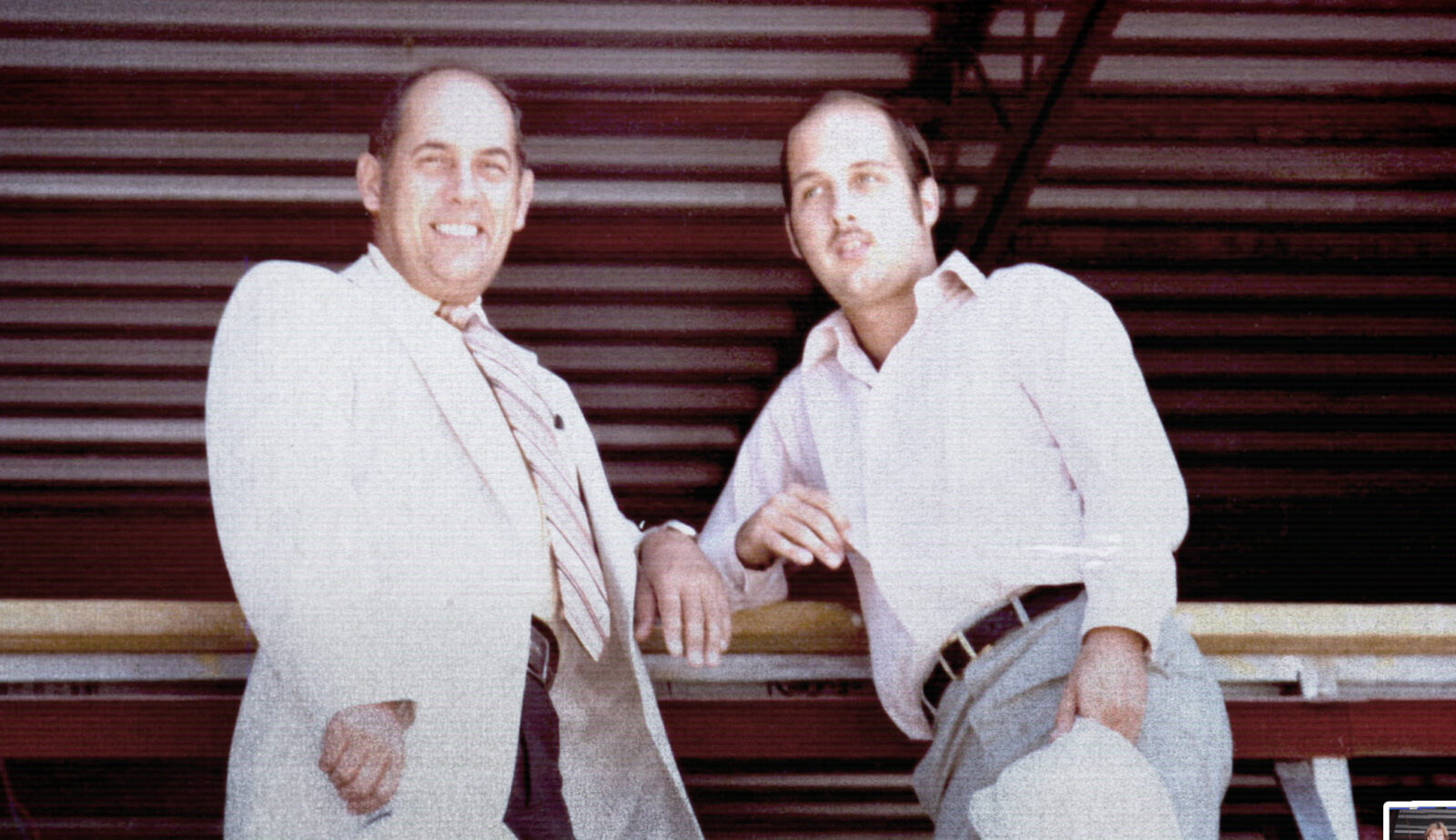
With the help of many amazing people — and more than a little bit of luck — we went on the air just over a year later on Sept. 7, 1979.
In between, Getty Oil committed more than $100 million to fund the venture; we obtained the rights to broadcast an unprecedented range of NCAA events; and we sold Anheuser-Busch the then largest contract in cable television history.
Still, when director Greg DeHart called and asked if I would participate in the documentary, I hesitated.
For me, the ESPN saga was complicated.
The rapid transition to a cold and ruthless corporate world was painful. More painful was what the transformation did to me — I didn’t like the person I became. It took a long time for me to heal, find myself again and return to my faith.
In addition to being an accomplishment I’m proud of, it was also a soul-crushing experience. In fact, there were large stretches of my life when I wished ESPN had never happened.
In just under 13 months, I went from being a light-hearted volleyball-playing beach bum to doing battle at the C-suite level of the 35th biggest company in the world.
The rapid transition to a cold and ruthless corporate world was painful. More painful was what the transformation did to me — I didn’t like the person I became. It took a long time for me to heal, find myself again and return to my faith.
So, before agreeing to be interviewed, I asked Greg a straightforward question: Did he want to tell a fairy tale or tell the truth?
In my skepticism, I assumed the Disney-owned sports network was interested only in the fairy tale version. Over the course of a 45-minute Zoom call, however, Greg convinced me that he knew enough of the underlying story to know the difference.
More importantly, he convinced me that he wanted to tell the truth.
We eventually set a date and found a location for what turned into a four-hour interview. It began with questions about my childhood and Greg seemed a little disappointed with my answers.
My father worked nights at a TV station and left for work before I got home from school. During the summer, I lived with my grandparents, so our paths didn’t cross much.
When Greg pushed and asked how my father and I had bonded over sports, I couldn’t really answer.
So, I told him that “music was also a huge part of my life growing up… That was probably an area of contention with my parents.”
Maybe I was reading too much into it, but it felt like the interview had gotten off to a bad start — it wasn’t what Greg wanted to hear.
Along the way, things got better as the interview covered the basics.
Yes, the company was initially going to offer local sports programming to Connecticut cable systems. Yes, we took a total of $9,000 in cash advances from our credit cards to launch it. Yes, one of the biggest marketing flops of all time pointed us in an exciting new direction.
That marketing flop was pitching our idea for covering Connecticut sports to a gathering of Connecticut cable operators who basically laughed us out of the room. Fortunately, one of the cable operators suggested that if we were serious, we should look at this new thing called satellite broadcasting.
We followed up on that suggestion and two days later met with the RCA satellite salesman, Al Parinello. That meeting began a lifelong friendship and changed the trajectory of our lives.
Al taught us a lot about how the satellite worked, and we learned new terms like geo-synchronous orbit. But what grabbed my attention were the numbers.
As Al talked, I did the math and was completely blown away. By using the satellite, we could send a broadcast signal across America for less money than it cost to send the same signal around the tiny state of Connecticut via traditional land lines.
Before knowing what precisely we might do with it — or how we would pay for it — we agreed to a five-year, $2.6M contract for a satellite transponder. That was the best decision we ever made. Still, to secure the deal, we needed to come up with a fully refundable deposit of $34,167.
Wow! Talk about a game-changer! Al later said he saw me almost jump out of my chair with that discovery.
I didn’t know it at the time, but seeing opportunity in new technology was to become a defining feature in my career.
I’m currently partnering with Jigsaw, a Google tech incubator, to develop Artificial Intelligence (AI) tools that will provide a better understanding of public opinion. Our “We The People” project will play a role in America’s 250th birthday celebration.
Back in 1978, however, I was just excited.
When Al left, I exuberantly told my father we should sign up for three transponders (naively ignoring the fact that we couldn’t even afford one).
This distribution capability is what made ESPN — and the entire cable television revolution — possible.
Before knowing what precisely we might do with it — or how we would pay for it — we agreed to a five-year, $2.6 million contract for a satellite transponder. That was the best decision we ever made.
Still, to secure the deal, we needed to come up with a fully refundable deposit of $34,167.
A friend introduced us to JB Doherty, who became an investor, financial advisor and much more.
He graciously advanced the deposit amount before we even signed a working agreement. Not only that, he and his partners continued to provide all the seed funding needed to keep us afloat for months until Getty invested.
JB is one of the seven or eight people who can honestly say that ESPN would never have happened without them.
In addition to bringing our project to potential investors, he convinced RCA, the NCAA, cable companies and others to treat our underfunded start-up company seriously. Without his assurances, none of them would have given us the time of day.
The absurdity of our situation was breathtaking. As we waited for that first wire from JB, we foolishly convinced ourselves that he would round up the amount to $35,000 and planned to use the extra $833 to make some credit card payments and pay the phone bill.
It’s hard to overstate the frustration and pressure we felt every hour of every day. We had discovered a game-changing technology, didn’t know what to do with it and had committed to a $2.6M contract with no money in the bank.
We had no reason to think he would do so but were devastated when JB sent only the exact amount needed to pay RCA.
Still, we were thankful that one problem was solved and then figured out a way to deal with the next.
That approach became a pattern we repeated during the creation of ESPN.
It’s hard to overstate the frustration and pressure we felt every hour of every day. We had discovered a game-changing technology, didn’t know what to do with it and had committed to a $2.6M contract with no money in the bank.
The content needed to fill 8,760 hours a year was hard to envision in an era when MSG Sports would show a New York Knicks game and sign off the air for days until a New York Rangers game popped up.
Local TV stations still went off the air overnight and played the national anthem before signing off.
There were simply no models to follow in a world with only one college football game on television each week. So, we kicked around lots of programming ideas, mostly about sports, but not all.
Some of them were quickly dismissed while others seemed to be getting close. Despite obsessing over it every waking moment for a month or so, none of the ideas seemed quite right.
Then, on Aug. 16, 1978, the second magic moment arrived in a traffic jam near Waterbury, Connecticut. My father and I were arguing about what the programming should be, and I’d had enough.
“Show football all day, see if I care,” I screamed.
Suddenly, we stopped arguing and everything fell into place. Before the day ended, the idea of showing all sports, all day, every day was so real we could taste it.
We believed we had an idea that would change the world and were too stupid to know it couldn’t be done. Initially, we tried to keep the idea close to our vest because we feared that as soon as somebody saw it, they would steal it.
Over the next several months, we learned that the reality was much different as we experienced rejection after rejection.
COMING FRIDAY PART 2: A Crazy Path To Finding The Money